Thursday, April 5, 2012

Zhen He and his Treasure Fleet - A Biography

Please mind my spelling.
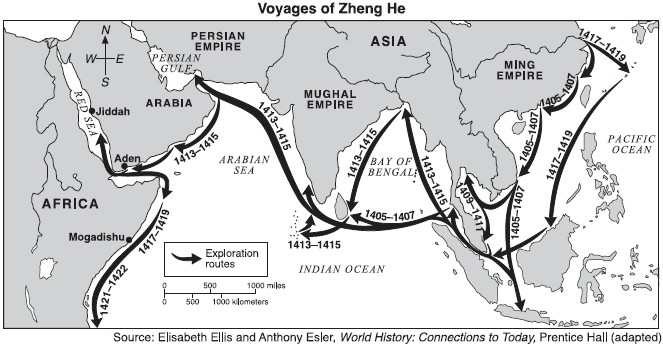
Zheng He was born in the Chinese province of Yunan, which is a rural farm town towards the south of China. Although he considered himself to be Chinese, his father had Arabic ancestry, wherefore Zhen He always felt drawn towards the Middle East later in his life. He spent the first 10 years of his life in Yunan, but as Mongot troops invaded the Mind empire, the royal army was sent to Yunan to block them. This was a prominent event in Zhen He's early life because his father was executed and Zheng He was castrated, which enabled him to become a eunic government official. He was brought to the Royal Palace in Nanjing, which was the Ming capital, to serve a rebellious young Chinese prince. In 1402, Zhu Di became the next Ming emperor. He was the one who ordered the building of the "Treasure Fleet", which was meant to expand China's influence on the rest of the world. It consisted of over 300 ships, with each one being around 500 feet long. During this time, the eunic's and the emperors view highly conflicted with that of the Confucian scholars, who did not want to explore, but instead restore Chinese tradition. Depsite their disapproval, Zhu Di commanded the launch of the Treasure Fleet in 1405, with the leader being Zhen He. In all, the treasure fleet made 6 successful voyages. Before each, Zheng He took time to write letters to his father, asking for his blessing for a safe voyage. In his voyages, he passed by Indonesia, where he settled conflicts among the violent inhabitants. Here, he is remembered for his diplomacy and is still honored like a god. On his way through the Malacca strait, Zheng He encountered pirates, who attacked him, but he trapped them, bringing peace to the waters of the Indian Ocean. Throughout all his voyages, he also set up strategic trading posts, with the largest one being at Malacca, enabling not only more trade for the Chinese, but also for the rest of the world. Zhen He's next stop was at Sri Lanka, where he wanted to make peace with the Buddhist Chief - He gave him a huge three language stone tablet, which the priest did not accept. Therefore, the Treasure Fleet attacked, displaying an unstoppable amount of force, to which the Sri Lankans eventually gave in. For this, the world remembers Zhen He as one, who accepts religions. Indeed, Chinese were very tolerant of all religions around the world. From this first voyage, Zheng He returned to China as a national hero.  On his next voyages, Zhen He stopped at Malabar and Calicut in India, where he traded for "black gold" - pepper. Spices were the most sought-after goods for the Chinese, so Zheng He really enjoyed his time in India. This is the place where he found the religious harmony that he was looking for in all the places he had been to before. Some say Zhen He stayed in India for more than 10 years, but he also travelled farther west to the Arabian Peninsula, perhaps to learn about his ancestors. Zheng He was a devoted Muslim, so perhaps he also wanted to complete his pilgrimage to Mecca. It is unknown wether he ever succeeded. Then Zheng He's luck changed, with the switch of power back in China - a new emperor rose in 1424 after Zhu Di died from illness. Meanwhile, the imperial finances were depleted from constant exploration. Because Confucians convinced the new emperor to quit his explorations and enforce traditions, Zheng He went on his 7th and final voyage in 1431, from which he never returned. No one knows what happened to Zhen He, if he reached a destination, if the fleet sank, or if the crew was ambushed. Zheng He's empty tomb lies in Nanjing, while Zhu Di resides in one of the Ming's royal tombs. Nevertheless, Zheng He is remembered for his fierce displays of force and his religious tolerances. He is probably the reason why there are so many Chinese settlements and communities outside of China. When native Chinese heard of foreign wealth, they were drawn outside, before Confucian isolation policies took their toll on society and economy.
   

Wednesday, February 1, 2012

Islam

When? 1,400 years ago.
Where? In Mecca, on the Arabian Peninsula.
Who? Mohammed was the prophet of God, who heard his words and spread his teaching. Later, his followers, including Moses and Abraham, and missionaries collected these teachings and continued the spread. Islam first made its spread to Persia, and then to the rest of the world. Their teachings are collected in the Muslim holy book, the Qur'an.
What? There is only one God, who taught the people how to live and behave. Muslims follow the five pillars of Islam.

Christianity

When? Around the year 0.
Where? Jesus was born in Betlehem, in the Hold Land. That is modern day Israel. Christianity later spread to the Roman Empire, from where it continued to thrive.
Who? Jesus Christ, the son of God, is said to be the savior of the people. He spread his teachings through his 12 disciples. Later, missionaries kept spreading the beliefs.
What? There is only one God. And God's teachings are collected in the holy book, called the Bible. There are now several different branches of Christianity, including the Catholic Church.

It was so appealing to the Romans, especially the poor, because they thought it would save them from their fate. They believed it would bring them a better life. Later, Constantine saw it as an easy method to gain control over the people, so he stopped perescuting Christians and encouraged them to practice their faith.

Monday, January 23, 2012

Alex the GREAT!

Alexander was born in 356 B.C.E, son to the Philip II, the ruler of Macedonia. During his childhood, he watched his father transform Macedonia into a deadly war-machine, which conquer any land. His father hired the Greek philosopher Aristotle, as Alex's teacher, giving him the opportunity to develop his interests in science, medicine, philosophy, and literature. At the age of 16, his father left the country to conquer some neighbors, and Alex was left to rule. This shows that his father trusted him to be mature enough to take responsibility at such an early age. Indeed, he repressed a rebellion from a neighboring country of Macedonia (Thrace), took over their cities and renamed them Alexandropolis, after himself. He also conquered Greece at the age of 18, when his father put him in command of troops. When his father remarried, his wife's uncle indirectly insulted Alexander, who therefore threw his cup of wine in the man's face, wherefore his father assaulted him. Philip was assasinated and Alex was left to rule the fast empire.

What made Alex so successful were his strategics and his speed. He managed to cover a distance of 240 miles in just 2 weeks: with an entire army. During the beginning of his reign, he had to surpress Greek and other revolts, only after which he could give his attention to further conquests. He took over all of the Greek mainland and advanced to Persia and the rest of Asia Minor. He is well known for his respect towards victims of his conquests, especially Darius and his family. He then conquered Phoenicia and Syria, followed by Egypt, where he marched to an oracle, in order to gain respect from the Egyptians, as their rightful king. This shows that he accepted other culture's beliefs. He was also very fair when facing Darius' revolting attack in Babylon, he chose to start battle in the morning, instead of taking advantage of the night. Nevertheless, he won anyways, but Darius fled. When he later found Darius assasinated, Alex gave him a noble royal funeral and paid his respects, before avenging the Bactrian murderer. Later, he invaded the Punjab of India, but his men refused to go on, as they were already so far away from their homeland. Therefore, they returned, loosing many men on the way. When the were back, Alex held huge celebrations at Susa and married himself and many of his men to Persian noblewomen, as well as legalizing past marriages between his soldiers and native women. He wanted to create a new dynasty of mixed ancestry. He planned a campaign against Arabia, but shortly after that he contracted a high fever and died in 323 B.C.E.

Alexander hadn't left a successor to his vast empire, so chaos was, as always great. Through his many conquests, he had sped the spread of ideas, bringing Greek culture to new parts of the world. Through Greek language, ancient Jewish scriptures were translated, making Judaism and Christianity available to many others. Alex remains to be known for his violent temper after too much wine at his festivities, but he was still the great conqueror on the outside.


http://www.historyofmacedonia.org/AncientMacedonia/AlexandertheGreat.html
http://jasonretherford.wordpress.com/2005/04/21/alexander-the-great-and-his-influence/
http://www.ancientsites.com/aw/Article/777720

Friday, December 9, 2011

Persia: Cyrus, Darius, Xerxes

cyrus2/cyrus55.jpg

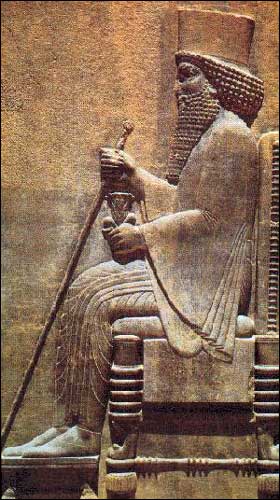
Cyrus the Great, Darius the Great and Xerxes were the three most important rulers of the Achaemenids, Persia's original dynasty. All of them greatly contributed to the rise and expansion of the Persian Empire.

Cyrus:
  • He was one of the first great Persian kings, responsible for the actual "foundation" of the empire. He was the conqueror of Lydia, Ionia (the Greeks), and Babylon.
  • One of his greatest deeds was freeing the Jews from Babylon, and allowing them to return to their homeland. This shows his great toleration for other ethnicities and religions.
  • During his reign, the first great Persian capital, Pasagardae, was built. This was the place, from which Cyrus ruled, and where he was later buried in a simple tomb, without much grandeur or luxury. This was his will, as he wanted to be remembered as a king, who didn't see himself superior to his people: he enjoyed the simple life.


Darius:
  • Darius was a king, who emerged from a continuous struggle for power within the Persian Empire. It took him over a year to put down revolts and really take up his position as head of an empire. Darius continued conquests that Cyrus had started earlier, and made Persia one of the biggest, or perhaps THE biggest empire that the world had ever seen. His lands ranged from Macedonia, over Northern Africa and Egypt, all the way to Northern India.
  • To control such a vast amount of land, Darius worked on creating a new political system, which involved states known as satrapies with localized leaders, who were subject to Darius' central government. He required them to pay taxes annually, in the form of a standardized currency throughout the whole empire. He set up a system of "spies", who made sure that the satraps did as they were told.
  • One of Darius' most significant accomplishments was the building of the Royal Road, which enabled communication and long distance trade throughout the whole empire. The state had several rest and refreshment stations with new horses, which allowed for continuous travel, without many breaks.
  • Darius started the war with Greece to teach revolting Ionian states a lesson, unlucky for him, they were supported by the Greeks.

Xerxes:
  • After Darius' defeat in Greece, his son Xerxes continued this fight, and is therefore mainly known for his great invasion of Greece. He alligned a fleet of ships over a turbulent strip of sea, to be able to cross from Asia into Europe. He built a bridge over ships! nevertheless, he still wasn't able to defeat the Greeks, and returned home.
  • Xerxes didn't tolerate different religions and beliefs as well as his predecessors, which caused resentment and revolts from within the empire. He was able to successfully repress these rebellions.
  • Xerxes reign marked the beginning of the decline of the Achaemenids. He was murdered by government officials, as were several of his successors.
(book) (movie)


Monday, November 21, 2011

MAYA

Amazing!


The Maya were probably one of the most dominent and influential cultures of Mesoamerica, more precisely Mexico and Guatemala. Their culture flourished (about 1800 BCE) after the decline of the Olmecs, and that the Olmecs had a vast influence on them was evident. The Mayans didn't really have a central government, like most Mesopotamian Empires we have studied, but they had several small, organized states, that were centers of trade and communication. The Mayans used their own hieroglyphic writing, consisting of pictographs, but also of "letters" that represented sounds. They were very advanced in the fields of astronomy and math, having calculated that an

 The Mayans making their special cacao drink

astronomical year would take exactly 365 days; they were only seconds off the modern calculations. What we remember most about the Mayans, are their cruel religious practices and ceremonies, often performed to the public. They included human sacrifice and blood-letting to please the gods. As time passed, the Mayans turned from a rather peaceful society, to a more violent one, as city-states started to become rivals. They fought each other constantly, and it is still debated today, if that was the reason for their downfall around 900 CE. Another factor leading to their disappearance might have been the depletion of their fields, and the loss of fertility of the soil. Maybe a natural disaster caused them to leave. We don't know.

For me, the Mayans major accomplishments might be different than what some other people consider as their major accomplishments... Please excuse my horrible judgement :)
  1. The Discovery of Cacao (CHOCOLATE): The Mayans collected Cacao beans from tropical trees, dried them, ground them into a powder, and mixed this powder with water to create a chocolate drink, which was reserved most exclusively for the elite class. Now, it makes me feel special every single time I eat chocolate (so like, once a day) because I know where it originally came from.
  2. Their Ancient Ball Game: Since we don't know exactly how they played this game, but we know that involved a court, a "hoop", and a hard ball, I assume it was very similar to Basketball. I love (to watch) Basketball, and I find it amazing that even the ancient societies had nothing to do with their free time, so that they invented one of the first sports ever.
  3. Their Calendar: Wow. That is all I can say. The Mayans had their very own calendar, not only did they calculate exactly the right amount of days, but they also found out what kind of activitites to do on each day, as the stars, moons, and other planets rotations, apparently influenced how events would turn out. They even predicted the end of the world, and that every 52 years or so, the cycle of the planets would start the same way over again. With their calendar, they knew when to plant crops, making them some of the most successful agricultural people ever. They could even have several growing seasons.
An ancient Mayan Ball Court.

An ancient Mayan Calendar.

Monday, November 14, 2011

The Social System of the Aryans

  • The caste systme originated as the Aryans developed their settlements in India. At first, people were "classified" by their varna, or the color of their skin. This racism later evolved into classification by job. There were thousands of subcastes and jati, each one for another specialized job. At the top of the caste system were priests, warriors and aristocrats, while the bottom classes were taken up by landless peasants and slaves.
  • Varna means "color" in the language Sanskrit, which is ancient Indian.
  • The four main varnas were brahmins or priests, kshatriyas were warriors and aristocrats, vaishyas were artisants, farmers and merchants, and shudras were landless peasants or serfs.
  • The later fifth varna was that of the "Untouchables", who were viewed as the "dirt" of society. They did all the jobs that no one else wanted to do, including hard labor and other dirty work. They were believed to be so full of germs, that you could get infected just by touching them, so nobody would ever want to come near them.
  • Jati was another word for a subcaste, so a separate group within one of the varnas.
  • General rules of jati included that when you were born, you belonged to the same jati as your parents, and you couldn't do much to change that. You usually married people and only spent time with the people that belonged to the same jati as you. Some people became more loyal to their yati than to the government or their religion. You had to treat the people of a higher jati with great respect.
  • If rules were violated, you were "expelled" from your jati, meaning, you belonged nowhere. And it is very hard to function all alone because everyone looked down on you if you were an outcaste.
  • Aryans believed that the caste system made it easier to govern society, as each jati had specific rules. With the caste system, everybody had a task, nobody was "jobless", so it was a great system to get people to do their work. Everybody worked to their full potentional, in the hope of improving their position and moving up one jati in society, which rarely happened to individuals, but more likely to a whole jati from group effort.
  • The Upanishads were literary and oral works concerning religion, moral issues, meditation and philosophy. Often, they were delivered by a sage with disciples listening to discuss the issues.
  • Brahman is the universal soul, or the Earth system as a whole. It is a foundation of all things existing, and it is stable and unchanging.
  • Samsara is a belief that when someone dies, they temporarily go to a heaven-like place, and are then reborn into a new existence.
  • Karma is the specific existence that someone was reborn into. If you lived a pure life, you were reborn into a better life, for example into a higher jati. But if you lived in sin, you were reborn into a worse life.
  • Moksha breaks the cycle of rebirth and lets your soul rest in a state of "dreamless sleep". To attain moksha, you had to lead an extremely simple, pleasure-free life, and meditate until you reached "enlightement".
  • The Upanishads were often used to justify the inequality created by the caste system. They stated why one was born into a caste - because of the way one had lived their previous life.