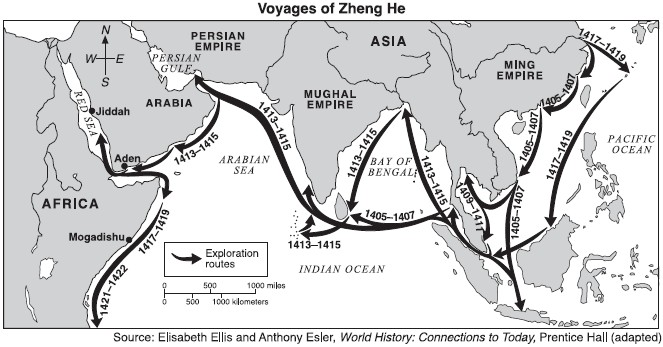
Zheng He was born in the Chinese province of Yunan, which is a rural farm town towards the south of China. Although he considered himself to be Chinese, his father had Arabic ancestry, wherefore Zhen He always felt drawn towards the Middle East later in his life. He spent the first 10 years of his life in Yunan, but as Mongot troops invaded the Mind empire, the royal army was sent to Yunan to block them. This was a prominent event in Zhen He's early life because his father was executed and Zheng He was castrated, which enabled him to become a eunic government official. He was brought to the Royal Palace in Nanjing, which was the Ming capital, to serve a rebellious young Chinese prince. In 1402, Zhu Di became the next Ming emperor. He was the one who ordered the building of the "Treasure Fleet", which was meant to expand China's influence on the rest of the world. It consisted of over 300 ships, with each one being around 500 feet long. During this time, the eunic's and the emperors view highly conflicted with that of the Confucian scholars, who did not want to explore, but instead restore Chinese tradition. Depsite their disapproval, Zhu Di commanded the launch of the Treasure Fleet in 1405, with the leader being Zhen He. In all, the treasure fleet made 6 successful voyages. Before each, Zheng He took time to write letters to his father, asking for his blessing for a safe voyage. In his voyages, he passed by Indonesia, where he settled conflicts among the violent inhabitants. Here, he is remembered for his diplomacy and is still honored like a god. On his way through the Malacca strait, Zheng He encountered pirates, who attacked him, but he trapped them, bringing peace to the waters of the Indian Ocean. Throughout all his voyages, he also set up strategic trading posts, with the largest one being at Malacca, enabling not only more trade for the Chinese, but also for the rest of the world. Zhen He's next stop was at Sri Lanka, where he wanted to make peace with the Buddhist Chief - He gave him a huge three language stone tablet, which the priest did not accept. Therefore, the Treasure Fleet attacked, displaying an unstoppable amount of force, to which the Sri Lankans eventually gave in. For this, the world remembers Zhen He as one, who accepts religions. Indeed, Chinese were very tolerant of all religions around the world. From this first voyage, Zheng He returned to China as a national hero. On his next voyages, Zhen He stopped at Malabar and Calicut in India, where he traded for "black gold" - pepper. Spices were the most sought-after goods for the Chinese, so Zheng He really enjoyed his time in India. This is the place where he found the religious harmony that he was looking for in all the places he had been to before. Some say Zhen He stayed in India for more than 10 years, but he also travelled farther west to the Arabian Peninsula, perhaps to learn about his ancestors. Zheng He was a devoted Muslim, so perhaps he also wanted to complete his pilgrimage to Mecca. It is unknown wether he ever succeeded. Then Zheng He's luck changed, with the switch of power back in China - a new emperor rose in 1424 after Zhu Di died from illness. Meanwhile, the imperial finances were depleted from constant exploration. Because Confucians convinced the new emperor to quit his explorations and enforce traditions, Zheng He went on his 7th and final voyage in 1431, from which he never returned. No one knows what happened to Zhen He, if he reached a destination, if the fleet sank, or if the crew was ambushed. Zheng He's empty tomb lies in Nanjing, while Zhu Di resides in one of the Ming's royal tombs. Nevertheless, Zheng He is remembered for his fierce displays of force and his religious tolerances. He is probably the reason why there are so many Chinese settlements and communities outside of China. When native Chinese heard of foreign wealth, they were drawn outside, before Confucian isolation policies took their toll on society and economy.



No comments:
Post a Comment